






Test yourself: Should I get a hearing test?
Answer the 4 questions below to see if you should consider getting a hearing test.
While it can be easy to take your hearing for granted, it is one of your most valuable senses. Being able to hear clearly makes it possible for you to communicate, build relationships and unite with your friends and loved ones. Learn what you can do to protect this precious sense.


While age-related hearing loss cannot be prevented, noise-induced hearing loss is preventable.
There are a few simple rules you can follow to protect your hearing health as much as possible, regardless of your age.


Answer the 4 questions below to see if you should consider getting a hearing test.
Your answers indicate that you experience symptoms of hearing loss. We strongly recommend booking a hearing test in one of our clinics.
The result is an indication. An in-person hearing test can determine if you have a hearing loss.
Your answers indicate that you experience some symptoms of hearing loss. We recommend booking a hearing test in one of our clinics.
The result is an indication. An in-person hearing test can determine if you have a hearing loss.
Your answers do not indicate that you experience symptoms of hearing loss. However, if you experience trouble hearing, we recommend booking a hearing test in one of our clinics.
The result is an indication. An in-person hearing test can determine if you have a hearing loss.
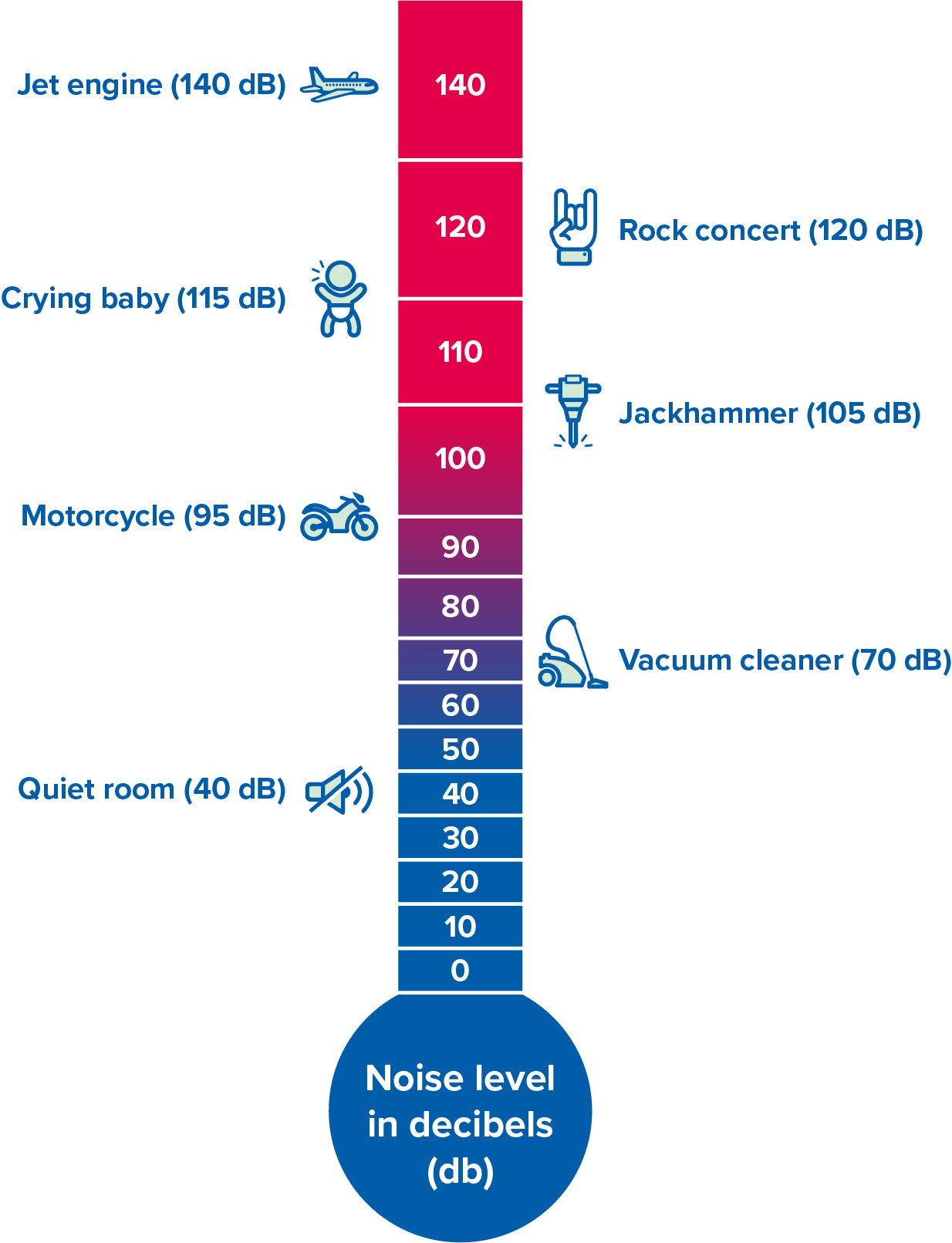
Sounds are considered harmful when they exceed 85 dB, which is similar to the loudness of heavy traffic. Sound levels can soar to harmful levels in our everyday lives more often than you might think. Here are some noise comparisons for reference to help you limit your exposure to loud noises and thereby prevent hearing loss:
Do you suspect that you already have some degree of hearing loss?
It is important to seek help as soon as possible since untreated hearing loss can deteriorate over time. We recommend that you book a free hearing test when you recognize the early signs in order to reduce the risks of untreated hearing loss.
When to seek help
You can protect your hearing by limiting your exposure to loud sound environments - or by wearing hearing protection (such as ear plugs or earmuffs) when you know you'll be exposed to loud sounds.



The most common cause of tinnitus is due to loud noise that damages the sensory hair cells in the cochlea (a shell-like organ in the inner ear where sounds are converted into electrical signals). Damage to the hair cells in our ear can cause both tinnitus and hearing loss.
In fact, more than 80% of people with tinnitus also experience some degree of hearing loss, but many tinnitus sufferers are not aware that their hearing is suffering too.

Enda Dooley is a qualified audiologist who holds a Higher Education Diploma in Hearing Aid Audiology from Queen Margaret University UK.
He has worked as an audiologist with Hidden Hearing for the last 16 years and his work provides him with the privilege of meeting, diagnosing and treating patients of all ages with diverse audiological conditions.
Enda is passionate about hearing health and personally invested in preventing the negative impact of hearing loss. His goal is to improve the quality of life for sufferers, their families, and friends.
Last reviewed 2025-07-01
1. Kochkin, Sergei (2009) ”MarkeTrak VIII: 25-Year Trends in the Hearing Health Market” The Hearing Review, vol. 16, no. 11.
2. McCormack, A. & Fortnum, H. Why do people fitted with hearing aids not wear them? Int J Audiol. 2013 May; 52(5): 360–368.
3. https://www.thelancet.com/journals/langlo/article/PIIS2214-109X(23)00514-4/fulltext
4. https://www.cdc.gov/niosh/noise/prevent/index.html